
A collision doesn’t have to mean the end of the road for a vehicle, but it does raise a question most owners aren’t prepared to answer: what actually happens next depends less on the damage and more on paperwork most people never think about until they need it. The problem is that guides on selling a damaged car tend to focus on cleaning it up and pricing it right, while skipping past the insurance and legal status questions that determine whether you’re even free to sell it yet. Getting this wrong can stall a sale for weeks or leave a seller exposed to disputes later.
This guide walks through exactly what status your vehicle is in, what you’re required to disclose, and how to move forward with confidence either way.
Ready to Sell a Car With Accident Damage, Repaired or Not?
Whether your vehicle was fully repaired, still has an open claim, or was declared a total loss, Scrap Auto Removal serves Calgary and more than 30 Alberta communities and buys vehicles with accident history in any condition. Get a quote or email [email protected] for a free, no-obligation quote.
Does an Accident Automatically Affect How You Can Sell the Car?
Not directly, no. An accident on its own doesn’t restrict a sale. What matters is what happened after it:
- Repaired, no open claim: sells close to a normal vehicle sale
- Repaired, claim still open: insurer may hold an interest until it’s settled
- Declared salvage or non-repairable: permanently changes what the vehicle can legally be used for
A repaired fender bender with no lingering claim is close to a normal sale. An open claim or a salvage brand changes the process meaningfully, both covered below.
Was the Vehicle Repaired and Kept, or Is There an Open Claim?
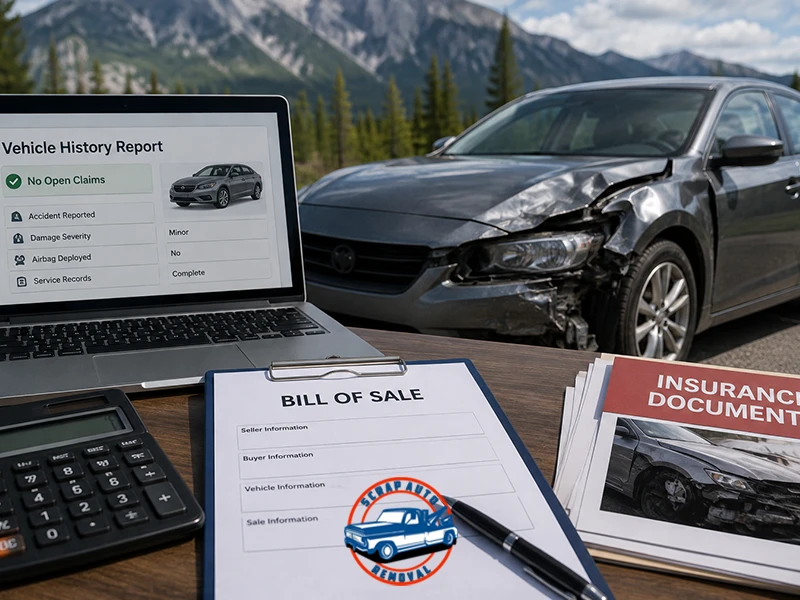
If the vehicle was repaired and you kept it, either you paid out of pocket or your insurer settled the claim and released the vehicle back to you, you’re free to sell it like any other vehicle, with its accident history as part of what you know about it.
If there’s still an open, unresolved insurance claim, the situation is different. Depending on your policy and how the claim was handled, your insurer may have an interest in the vehicle until the claim is settled, particularly if they’ve already paid out toward repairs or a total loss determination. Selling before that’s resolved can create real complications for both you and the buyer, so it’s worth confirming the claim status with your insurer before listing anything.
What Do You Actually Have to Disclose About Accident History?
This is where it’s worth being precise, because the rule is different depending on who’s selling.
| Seller type | Legal disclosure requirement |
|---|---|
| Vehicle dealer | Must disclose repairs over $3,000 (parts and labour) from an incident or collision, and any salvage/non-repairable status |
| Private seller | No legal obligation to disclose accident history, prior damage, or mechanical issues |
Not being legally required to disclose isn’t the same as it being a good idea to stay quiet. Undisclosed accident history that surfaces later, through a vehicle history report or a buyer’s own inspection, can damage your credibility and, in some cases, open you up to a dispute if a buyer can show you actively misrepresented the vehicle’s condition. Being upfront tends to lead to a smoother sale and a buyer who trusts the rest of what you’re telling them.
What Should You Actually Tell a Buyer, Even Without a Legal Obligation?
Since private sellers have flexibility here, it helps to know what actually matters to a buyer versus what’s just noise. A few things worth mentioning regardless of legal requirement:
- Whether the damage affected the frame or structural components, since this matters for long-term safety even after cosmetic repairs look perfect.
- Whether airbags deployed, since replacement airbags and sensors need to be done correctly, and it’s a reasonable question for a buyer to ask.
- What was actually repaired versus what was left as-is, especially if only cosmetic work was done on a vehicle with deeper damage.
- Whether you have the repair invoice or documentation, since this is often more convincing to a buyer than a verbal description.
None of this is legally mandatory for a private seller, but a buyer who feels like they got the full picture is far less likely to come back with a complaint or a lowball counteroffer after their own inspection turns something up.
When Does Accident Damage Cross Into Salvage Territory?
Alberta insurers typically declare a vehicle a total loss when repair costs approach 70 to 80 percent of its actual cash value. Once that happens, the vehicle usually gets branded one of two ways:
- Salvage: can potentially be repaired and re-inspected to return to the road as “rebuilt”
- Non-repairable: can never be registered for road use again, under any circumstances
This status follows the vehicle permanently and has to be disclosed by any licensed dealer who later sells it. If your accident damage is significant enough that you’re unsure which category it falls into, it’s worth confirming with your insurer or a registry agent before you start pricing the sale, since this status genuinely changes what a vehicle can legally be used for going forward.
- Read Also:
Does It Matter Who Was At Fault?
Not for your ability to sell the vehicle, no. Fault affects your insurance claim and premiums, not your legal right to sell a car you own. That said, it’s worth having your accident report or claim documentation on hand regardless of fault, since some buyers, particularly those doing their own research through a vehicle history report, will want to understand the full picture, and having clear documentation ready tends to build more trust than vague answers about what happened.
Selling With a Fully Repaired Accident History vs. an Unrepaired One
These are genuinely different conversations with a buyer:
| Fully repaired | Unrepaired | |
|---|---|---|
| Typical price | Close to a comparable accident-free vehicle, especially with a repair invoice | Lower, buyers price in the cost and hassle of fixing it |
| Buyer pool | Broad, most private buyers will consider it | Narrower, mostly buyers looking for a project or parts |
| What helps most | Repair invoice showing quality work | Honest description of exactly what's wrong |
Knowing which category your vehicle falls into shapes everything from your price expectations to which type of buyer you should actually be targeting.
What If You're Not Sure Which Category Your Vehicle Falls Into?
This happens more than people expect, especially with older accidents where the paperwork got lost or the repair was done informally years ago. We run into this constantly, someone calls certain their car is fine, only to find out mid-conversation that it was actually declared a total loss years earlier and quietly repaired and re-registered without them fully understanding what that meant for its status going forward. A few practical ways to figure out where you actually stand:
- Pull a vehicle history report. These pull from insurance and registration records and can confirm whether an accident, total loss, or salvage brand is on file, even if you don’t have your own paperwork anymore.
- Contact a registry agent. They can confirm a vehicle’s current status, active, salvage, non-repairable, or rebuilt, directly from Alberta’s registration system.
- Ask your insurer directly, if the accident went through a claim at any point, even years ago. They can usually pull up the claim outcome even if you no longer have the paperwork on hand.
Confirming this before you list the vehicle avoids the awkward situation of advertising it one way and having a buyer’s own research turn up something different.
FAQs About Selling a Car With Accident Damage in Alberta
Yes. If the vehicle was repaired and there's no open insurance claim against it, you can sell it the same way as any other vehicle. Its accident history is simply part of what a buyer may want to know, not a legal barrier to completing the sale.
Not legally, if you're a private seller, since AMVIC's disclosure requirements apply specifically to licensed dealers, not individuals. That said, staying quiet about known accident history can hurt your credibility if it surfaces later, so most sellers find it's worth disclosing upfront.
It depends on your policy and how the claim was handled. If your insurer has already paid toward repairs or a total loss determination, they may have an interest in the vehicle until the claim is fully resolved, so confirm this with them before selling.
No, fault affects your insurance claim and future premiums, not your legal ability to sell a vehicle you own outright. It's still worth having your accident documentation on hand regardless, since some buyers want the full picture before agreeing to purchase the vehicle.
A repaired vehicle with a closed claim can be sold and driven normally, like any other used car. A salvage vehicle has been declared a total loss and can't be legally driven or registered again until it passes a government inspection and is rebranded and rebuilt.
Yes, if the vehicle has valuable working components like the engine or transmission, selling parts individually can bring in more money than selling the vehicle whole. It takes more time, mechanical knowledge, and effort to list, price, and ship each part correctly, though.
The Bottom Line
Selling a car with accident damage in Alberta comes down to status more than condition. A repaired vehicle with a closed claim sells much like any other. An open claim needs to be resolved with your insurer before you sell. A salvage or non-repairable brand permanently changes what the vehicle can be used for. And while private sellers aren’t legally required to disclose accident history the way licensed dealers are, being upfront about it almost always makes for a smoother, more trustworthy sale. Knowing which situation actually applies to your vehicle is what determines your real options, not the damage itself.
References
Sources
- AMVIC (Alberta Motor Vehicle Industry Council) – vehicle condition and accident history disclosure requirements for licensed dealers
https://www.amvic.org/dont-be-surprised-by-vehicle-condition/ - AMVIC – buying used, understanding vehicle history
https://www.amvic.org/buying-used-understanding-vehicle-history/ - AMVIC – general code of conduct and Consumer Protection Act obligations
https://www.amvic.org/about-us/laws-and-regulations/general-code-of-conduct/ - Government of Alberta – Vehicle Bill of Sale form (ARP006)
https://formsmgmt.gov.ab.ca/Public/REG3126.xdp - Government of Alberta – Salvage vehicle inspections
https://www.alberta.ca/salvage-vehicle-inspections
Ready to Sell a Car With Accident Damage, Repaired or Not?
Whether your vehicle was fully repaired, still has an open claim, or was declared a total loss, Scrap Auto Removal serves Calgary and more than 30 Alberta communities and buys vehicles with accident history in any condition. Get a quote or email [email protected] for a free, no-obligation quote.