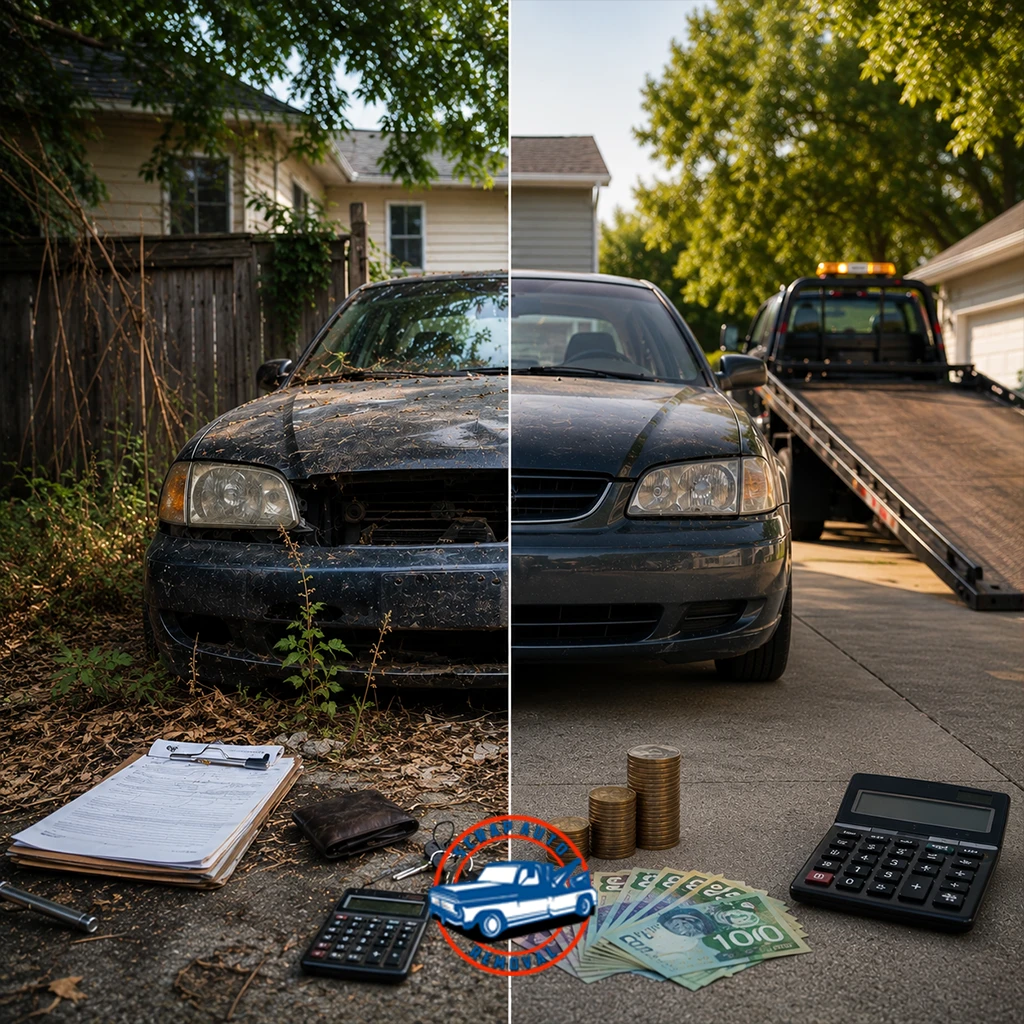

Is It Profitable to Sell Parts of a Damaged Car Separately in Alberta?

Is It Profitable to Sell Parts of a Damaged Car Separately in Alberta?

Michael Tremblay

August 27, 2026

12 mins to read

Michael Tremblay

12 mins to read

Parting out a damaged car can absolutely bring in more money than selling it whole, but more money isn’t automatically the same thing as more profitable once you actually count the time it takes. A lot of advice stops at “parts are worth more than scrap,” which is true, but it skips the part that actually matters to a real seller: how much time, effort, and uncertainty it takes to capture that extra value. Getting this wrong in either direction costs you, either you leave real money on the table by selling whole too quickly, or you sink weeks into listing and shipping individual parts for a return that barely beats what a single phone call would have gotten you.

By the end of this guide, you’ll know exactly which situation you’re in, and whether parting out your specific vehicle is worth the extra work.

Rather Sell It Whole and Skip the Math?

If parting it out yourself isn’t worth the time based on your own numbers, Scrap Auto Removal serves Calgary and more than 30 Alberta communities with a single offer that already factors in your vehicle’s parts and condition. Get a quote or email [email protected] for a free, no-obligation quote.

What Determines Whether Parting Out Is Worth It?

A few factors decide this before you even get into specific numbers:

  • Vehicle age and model demand. Popular, common models have a bigger pool of buyers looking for used parts. Rare or unpopular models can sit unsold for a long time, no matter how good the part is.
  • How many parts are actually sellable. A damaged car often has fewer genuinely sellable parts than owners expect, damage that seems isolated can affect adjacent components too.
  • Time and tools available. Removing parts correctly, without damaging them, takes real mechanical ability and the right tools.
  • Storage space. Parts need to sit somewhere while they’re listed, sometimes for weeks.

These four factors interact. A popular model with several intact, in-demand parts and an owner who has the time and tools is a genuinely different situation than a rare model with mostly damaged components and no garage space to work in.
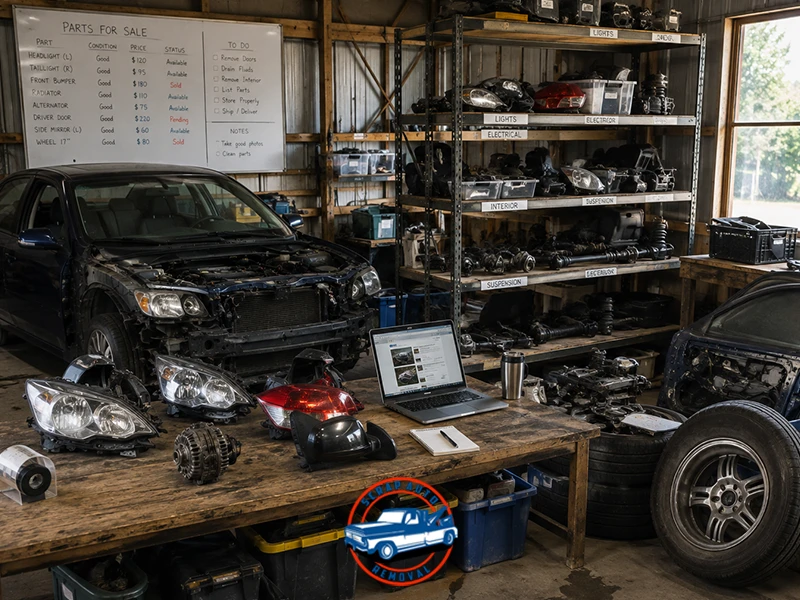
 

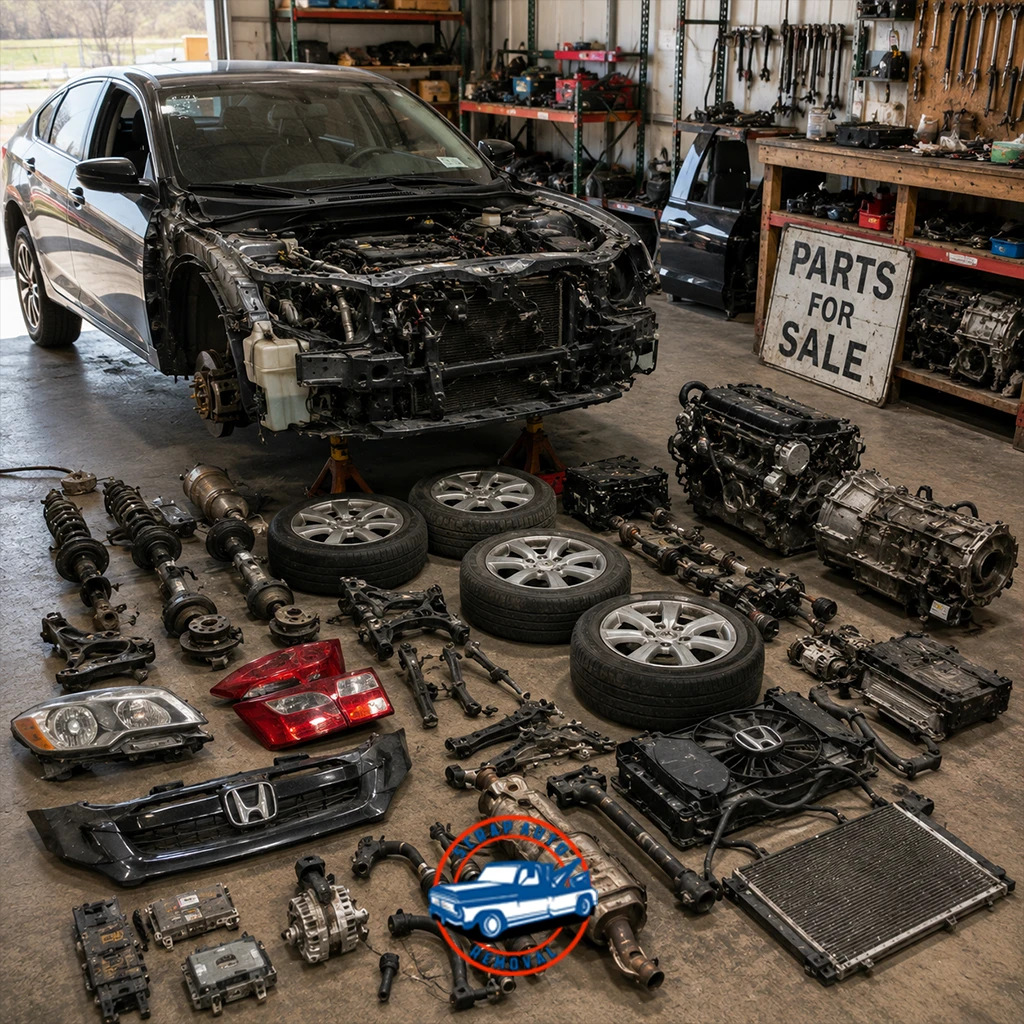
Sell Parts of a Damaged Car

The Real Time Cost of Parting Out a Car

This is the piece most advice skips entirely. Parting out a car isn’t just “remove parts, list them, get paid.” It’s a multi-step process, and every step takes real time:

  1. Removal. Safely taking out each part without damaging it or the parts around it.
  2. Cleaning and testing. Buyers expect to know a part actually works, or at minimum, exactly what condition it’s in.
  3. Photographing and listing. Every part needs its own listing with clear photos and an accurate description.
  4. Answering inquiries. Buyers ask questions about fitment, condition, and shipping, sometimes repeatedly, before committing.
  5. Packaging and shipping, or arranging local pickup. Heavier parts are expensive and awkward to ship, which sometimes limits you to local buyers only.

Experienced used auto parts sellers are consistent on one point: don’t expect anything to sell quickly. Long-time eBay parts sellers describe planning for the long term rather than expecting a fast turnaround, some parts sell within days, others sit for weeks or months. In our experience, the engine alone accounts for most of the delay, finding a buyer who needs the right compatibility and can arrange collection takes longer than most sellers plan for. That uncertainty is itself a cost, since your garage or driveway space stays tied up the entire time.

What You Actually Gain in Dollars

Here’s how individual part value tends to compare against what the same components contribute to a whole-vehicle offer, based on real Alberta and Ontario listings:

Car Parts Value Comparison
Component Typical individual sale value Rough contribution to a whole-vehicle offer
Engine (running) $400 to $800, depending on demand Meaningful, but folded into one number
Transmission $300 to $500 if functional Meaningful, folded in
Catalytic converter $150 to $500, luxury/rare models much higher Already factored into most direct-buyer offers
Body panels Moderate, model-dependent demand Small individual contribution
Electronics/sensors Low individual value, high total listing effort Minimal contribution

The pattern here matters: a small number of components, engine, transmission, catalytic converter, carry most of the real financial upside. Everything else adds marginal value for a disproportionate amount of listing effort.

A Worked Example: Doing the Math on a Real Vehicle

Take a 2011 mid-size sedan with a damaged body but a running engine and intact catalytic converter.

Selling whole to a direct buyer: A single quote, same-day pickup, cash on the spot. Based on typical Alberta condition-based pricing, this vehicle might land somewhere in the $500 to $900 range.

Parting it out: The engine might bring $400 to $800 to the right buyer, the catalytic converter $150 to $500 depending on the model, and the transmission $300 to $500, and various smaller components another $150 to $300 combined if everything sells. That’s a potential total of $1,000 to $2,100, genuinely more money on paper.

But that total assumes every part actually sells, at or near asking price, without significant delay. In practice, the engine alone might take weeks to find the right buyer, since it needs someone with a compatible vehicle and the means to install it. If it takes 15 to 20 hours of total time across removal, listing, communicating with buyers, and coordinating pickups or shipping, and the process stretches over a month or more, the extra $500 to $1,200 gained works out to a modest hourly return, once you also factor in the ongoing inconvenience of a partially disassembled car taking up space.

When Parting Out Is NOT Worth It

A few situations make the extra effort a clear loser before you even start:

  • The vehicle is a common model without strong parts demand. There’s little competitive advantage over just selling whole, since buyers can find the same part elsewhere just as easily.
  • Most parts are already damaged. Common with accident-damaged vehicles specifically, since one impact can affect several adjacent components, shrinking the pool of genuinely sellable parts more than owners expect.
  • You don’t have the time, tools, or storage space to do the work properly. Rushed or improper removal risks damaging parts that would otherwise be worth good money.
  • You need the space or cash quickly. Parting out is inherently a slower process than a single sale, sometimes stretching over weeks or months.

If two or more of these apply to your situation, selling whole is almost always the better call, not because parting out is a bad idea in general, but because the math stops working in your specific case.
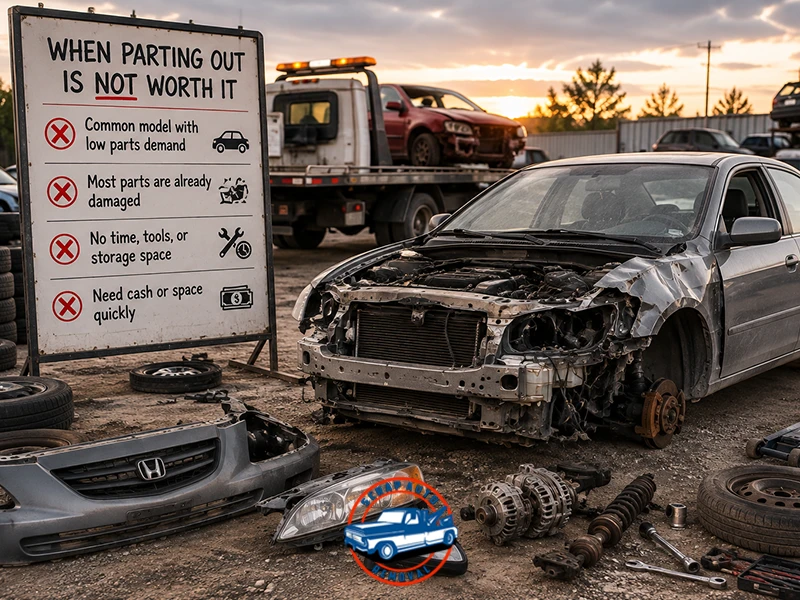
 

When Parting Out Is NOT Worth It

When It Genuinely Is Worth It

The reverse situation looks pretty different:

  • The vehicle has genuinely high-demand parts. A sought-after engine, transmission, or components for a popular model, where buyers are actively searching for exactly what you have.
  • You have real mechanical ability and the tools to remove parts correctly. Without damaging them or anything around them in the process.
  • There’s no urgency to clear the space. Parting out can take weeks to fully wind down, so patience matters more than speed here.
  • You’re comfortable managing multiple buyer conversations. Rather than the single, straightforward transaction a whole-vehicle sale involves.

This is really the mirror image of the first list, and most vehicles will lean clearly toward one side or the other once you’re honest about which factors actually apply.

FAQs About Selling Parts of a Damaged Car

FAQ - Selling a Damaged Car for Parts

It depends on the vehicle. Parting out can bring in more total dollars if the model has strong parts demand and most components are intact, but the added time and effort often shrinks that advantage once it's counted honestly against a single whole-vehicle offer.

The engine, transmission, and catalytic converter typically carry the most individual value. These three components drive most of the financial upside of parting out a car, while smaller parts like body panels and electronics add comparatively little for the listing effort involved.

It varies significantly and isn't quick. Experienced sellers describe planning for the long term rather than expecting fast turnaround, some parts sell within days while others, especially larger components like engines, can take weeks or months to find the right buyer.

Yes, meaningfully. Removing parts without damaging them or the surrounding components takes real mechanical ability and the right tools. Without that experience, the risk of damaging a valuable part during removal can significantly reduce what it's actually worth to a buyer.

Usually not as much as people expect. Common models have plenty of used parts already available elsewhere, which limits demand and pricing power. Selling whole to a direct buyer is often the more time-efficient option for an older, common vehicle.

Unsold parts can eventually be sold as scrap metal, though at a much lower value than a working part would have brought. Some sellers donate them or offer them at a steep discount just to clear the space rather than storing them indefinitely.

The Bottom Line

Parting out a damaged car can genuinely bring in more money, but only under the right conditions: a vehicle with real parts demand, components that are actually intact and sellable, and an owner with the time, tools, and patience to see it through. For a lot of vehicles, especially common models with significant damage, the math doesn’t favor the extra effort once time is counted honestly. Running the numbers on your specific vehicle, not a general assumption that “parts are always worth more,” is what actually tells you whether it’s worth doing.

References

Sources

  1. AMVIC (Alberta Motor Vehicle Industry Council) – vehicle and parts condition disclosure requirements
    https://www.amvic.org/consumer/buying-a-vehicle/buying-used/
  2. AMVIC – general code of conduct and Consumer Protection Act obligations
    https://www.amvic.org/about-us/laws-and-regulations/general-code-of-conduct/
  3. ScrapMonster Canada – live scrap steel and metals pricing by province, including Alberta
    https://www.scrapmonster.com/scrap-yards/prices/alberta/state/3006
  4. ScrapMonster – industry explainer on precious metal content and pricing mechanics in catalytic converters https://www.scrapmonster.com/news/catalytic-converter/understanding-precious-metals-in-catalytic-converters-2026-1-23/98246

Rather Sell It Whole and Skip the Math?

If parting it out yourself isn’t worth the time based on your own numbers, Scrap Auto Removal serves Calgary and more than 30 Alberta communities with a single offer that already factors in your vehicle’s parts and condition. Get a quote or email [email protected] for a free, no-obligation quote.

Next
Table of Contents

Share This Post

Lastest Post

How It Works

Request Quote
Receive Cash Offer
Accept & Schedule
Get Paid Cash

Michael Tremblay

Michael is a Calgary-based automotive writer with 8+ years covering Alberta’s used car and scrap vehicle industry, dedicated to giving readers simple, practical advice on selling their cars with ease.

Get Your Quote

Ready to Sell Your Scrap Car in Calgary?

Fill the form or call us. Most Calgary quotes are answered in under 5 minutes during business hours. Same-day pickup is available in all quadrants when you request before noon.

Our Blog Posts

Stay up to date with the latest car removal tips, scrap value trends, and guides for selling junk cars across Calgary and Alberta.
Scroll to Top