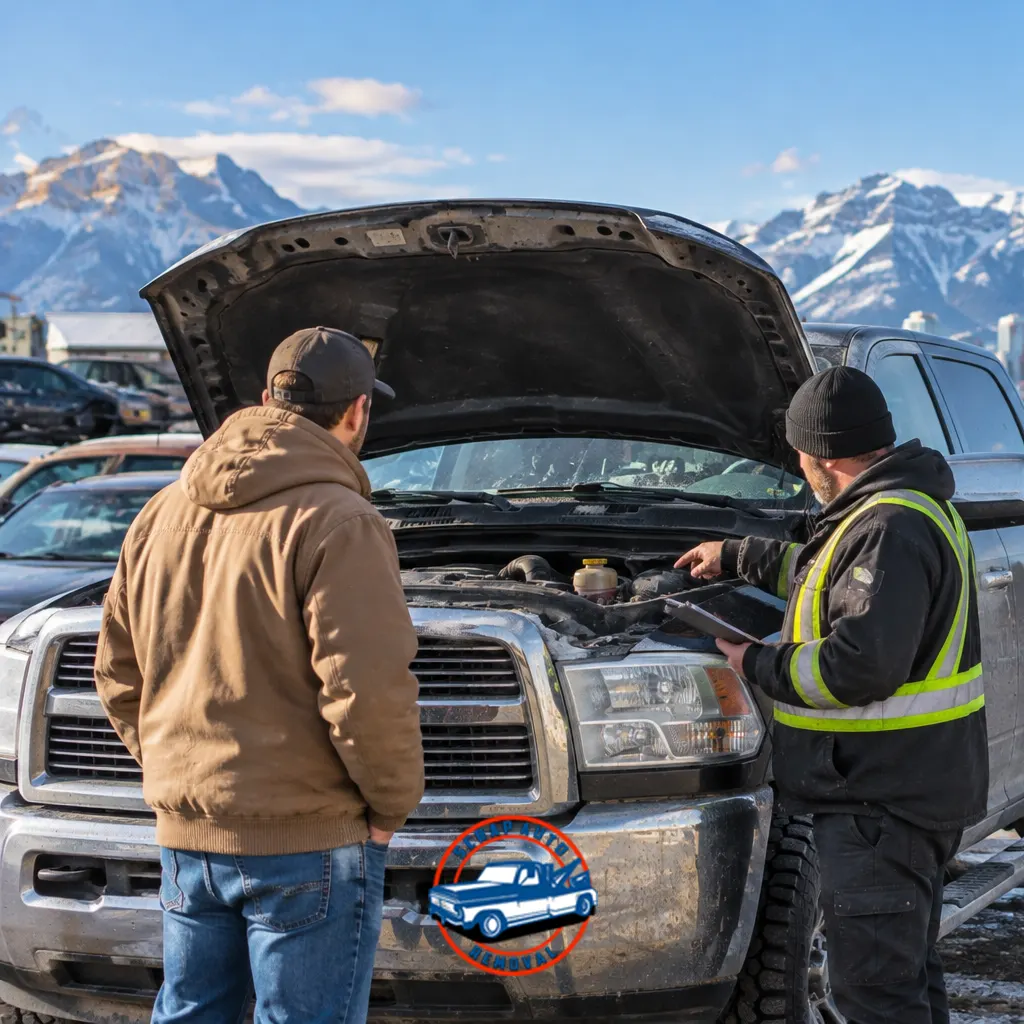

A grinding noise when you shift, a puff of blue smoke at startup, a truck that sags after towing. Together, they’re usually the earliest warning that a truck is heading toward a repair bill in the thousands, not the hundreds, and Alberta’s cold winters, gravel roads, and heavy towing use tend to bring these signs on sooner than a milder climate would. Ignoring the wrong sign can let a repairable problem develop into far more extensive transmission or engine damage. Knowing which signs point to a minor fix and which ones point to a major repair is what protects your wallet.
This guide breaks down the warning signs by system, what the major repairs typically cost in Alberta, and how to decide whether fixing your truck still makes financial sense.
Get a Free Quote
If a repair estimate has you wondering whether your truck is still worth fixing, Scrap Auto Removal can give you a straight answer. We buy trucks in any condition across Calgary and 30+ Alberta cities, with free towing and payment on pickup. Email [email protected] or fill out the form a free quote.
What Are the Warning Signs of Engine Trouble?
An engine’s warning signs are often the most visible ones, since they usually show up as something you can see, hear, or smell before a dashboard light ever comes on. Exhaust smoke color is one of the most reliable diagnostic clues available without a mechanic’s tools:
- Blue or gray smoke usually means the engine is burning oil, often from worn valve seals or piston rings
- White smoke that doesn’t clear within a few minutes of driving is often one of the more urgent signs on this list, since it commonly points to a coolant leak into the combustion chamber or a failing head gasket
- Black smoke usually means the fuel mixture is running too rich, though the underlying cause varies by engine and fuel system, from a clogged air filter on a gas engine to an injector or EGR issue on a diesel
On a cold Alberta morning, a brief puff of white vapor that clears within a few seconds of starting is just condensation, not a warning sign on its own. Smoke that lingers well past startup, in any season, is what’s worth paying attention to.
Knocking or ticking noises from the engine bay, especially under load or acceleration, and oil consumption that’s noticeably higher than it used to be between changes, are both signs worth taking seriously even without visible smoke. A light tick that fades as the engine warms up is often related to a lifter or other valvetrain component not yet getting full oil pressure, while a deeper knock that gets worse under load points to something more serious, like rod or bearing wear. A check engine light backed by a diagnostic scan is worth taking seriously too, since some fault codes point to a simple sensor while others point to a much larger problem.
Many parts stores will pull the code for free, though a proper diagnosis by a mechanic is the only way to know for certain what it means for your specific truck.
- Read Also:
How Do You Know the Transmission Is Failing?
Transmission problems tend to announce themselves gradually before they fail outright, which gives an attentive owner a real window to catch them early.
- Grinding or hard shifting between gears, particularly noticeable when the transmission is cold
- Slipping, where the engine revs without a matching increase in speed
- Delayed engagement, a pause between shifting into drive or reverse and the truck actually moving
- A burnt smell or visibly dark, gritty transmission fluid, rather than the clear reddish color it should be
- Fluid leaks under the truck, since a transmission that’s low on fluid wears out its internal components faster
Any one of these on its own might be a minor fix. Several appearing together, especially in a truck that also tows or hauls regularly, usually means the transmission is already under more strain than it can handle. Some modern automatic transmissions can also enter a protective “limp” or fail-safe mode when the control system detects a serious fault. Harsh or delayed shifting can be one warning sign of this, though there isn’t a single failure sequence every transmission follows.
Cold weather adds a wrinkle here too. A harsh or delayed shift on a cold start during an Alberta winter, one that smooths out once the truck’s been driving a few minutes, is often just thick, cold transmission fluid rather than a real fault. The same harsh shift happening consistently, cold or warm, is the one that points to an actual problem.
What Drivetrain and 4x4 Noises Should Worry You?
This is where truck-specific problems show up that a sedan or hatchback simply doesn’t have to deal with. Four-wheel-drive systems add a transfer case, a front differential, and extra driveline components, all of which can fail independently of the engine or transmission.
- A grinding or clunking noise when engaging or disengaging 4WD, which can point to a transfer case problem, though worn differential components or low fluid levels can cause similar symptoms
- Whining or howling from the front or rear differential, especially at highway speed
- Clunking noises during turns, which can indicate a worn differential or driveline component
- Vibration that changes with speed, which often traces back to a driveline or U-joint issue rather than the tires
These systems get less attention than the engine or transmission, but repairs here can be just as expensive, particularly on a truck that’s been used for real towing or off-road work. These issues also tend to show up gradually with mileage and use, and they’re more common on trucks that see regular gravel roads, farm and acreage work, or oilfield use, all of which put extra stress on the components involved.
How Can You Tell the Suspension or Frame Is Failing?
A truck’s suspension and frame take a different kind of punishment than a car’s, especially one that’s regularly loaded down with cargo or a trailer.
- A rear end that remains noticeably low after a load is removed, or that sags more than it used to under the same load, which can point to worn or damaged suspension components rather than the normal squat a truck shows while still loaded
- Uneven or unusually fast tire wear, which often points to worn suspension components rather than an alignment issue alone
- Visible rust on the frame or undercarriage, a bigger concern on a truck’s ladder frame than surface rust on a car’s body panels
- A rougher, less controlled ride than the truck used to have, especially over bumps
Alberta’s winters make this section matter more than it would in a milder climate. Road salt accelerates frame and undercarriage rust, and a truck that’s spent years driving through slush and salt brine is carrying more hidden corrosion risk than its mileage alone would suggest. Getting underneath the truck, or having a mechanic check during an oil change, to look at the frame rails and the areas around the wheel wells can catch rust while it’s still surface-level rather than after it’s eaten through structural metal.
How Much Do These Repairs Typically Cost?
Knowing a repair is coming is only half the picture. Here’s what the major repairs from the sections above typically cost, though your actual quote will depend on the shop, the parts used, and your specific truck.
| Repair | Typical Cost Range (CAD) |
|---|---|
| Transmission rebuild | $2,800 – $7,500 |
| Transmission replacement | $3,800 – $8,000+ |
| Engine repair or rebuild | $2,200 – $6,400+ |
| Engine replacement | $3,000 – $10,000+ |
These ranges are grounded in real Alberta pricing where it’s available. A real Edmonton transmission shop puts its own average rebuild at roughly $3,000 and a full replacement at roughly $6,500, which sits comfortably inside the broader range above. A Calgary-focused cost-tracking service puts the average engine repair bill in the city at roughly $2,568, with most jobs landing between $2,212 and $3,566, a figure that can climb well past that for a full rebuild or replacement on a larger engine.
Gas four-cylinder engines tend to fall toward the lower end of these ranges, while full-size truck V8s and diesel engines can run substantially higher, since they’re bigger jobs with more parts and labor involved. Diesel repairs often run higher than comparable gas-engine work too, since diesel systems can involve more expensive components, higher-pressure fuel systems, emissions equipment, and specialized labor. Getting an actual estimate from a mechanic is the only way to know the real number for your specific truck.
Is It Worth Fixing, or Time to Sell?
Once you have a real repair estimate, the decision usually comes down to a simple comparison: how does the repair cost stack up against what the truck is worth, and how many more years of use are you likely to get out of it afterward.
A commonly cited rule of thumb is that once a single repair reaches roughly 50 percent of a vehicle’s current value, it’s worth seriously considering whether selling makes more financial sense than fixing it. Like any rule of thumb, it has exceptions. A younger, otherwise reliable truck might still be worth a repair that clears that threshold, while an older truck already carrying a few other issues might not be worth fixing well below it. It’s a useful starting point once you have a real number from a mechanic, not a hard rule on its own.
A repair that costs a small fraction of the truck’s value, on a truck you plan to keep for years, is usually worth doing. A repair that costs close to or more than the truck’s value, especially stacked on top of other aging components, is a different calculation entirely.
In our experience, the trucks that come to us after a major repair quote are often ones where the owner had already sunk money into smaller fixes for months beforehand, and the transmission or engine failure was really just the last straw on a vehicle that had been signaling trouble for a while.
Get a Free Quote
If a repair estimate has you wondering whether your truck is still worth fixing, Scrap Auto Removal can give you a straight answer. We buy trucks in any condition across Calgary and 30+ Alberta cities, with free towing and payment on pickup. Email [email protected] or fill out the form a free quote.
Frequently Asked Questions
What color of exhaust smoke means the most serious problem?
Persistent white smoke that doesn't clear after a few minutes of driving is often one of the more urgent signs, since it commonly points to a coolant leak or a failing head gasket. Blue and black smoke can also signal serious problems, so the color is a useful clue, not a final diagnosis on its own.
How much does it cost to rebuild or replace a transmission?
A transmission rebuild typically runs $2,800 to $7,500, while a full replacement usually costs $3,800 to $8,000 or more, depending on the shop, the transmission type, and your specific truck. A written estimate from a mechanic is the only way to know your actual cost.
Is a grinding noise from 4WD always a transfer case problem?
Not always. It can point to a transfer case issue, but worn differential components or low fluid levels can cause similar symptoms. A mechanic can usually narrow it down with a proper inspection, which is worth doing before the noise turns into a full failure.
How do I know if a repair costs more than my truck is worth?
Compare the repair estimate to what your truck would sell for in its current condition, not what you paid for it or what a new one costs. A commonly cited rule of thumb is that once repairs reach about 50 percent of that value, it's worth seriously considering whether selling makes more financial sense.
Does Alberta's winter make truck repairs more likely?
Yes, particularly for frame and undercarriage rust, since road salt used on Alberta roads accelerates corrosion on the metal components underneath a truck. Trucks driven through several Alberta winters often show more hidden wear and rust in these areas than their mileage alone would suggest, especially older or higher-mileage trucks.
The Bottom Line
Most expensive truck repairs don’t happen without warning, and Alberta’s winters and driving conditions tend to bring them on sooner than a milder climate would. Exhaust smoke, transmission slipping, drivetrain noise, and frame rust are all signs worth taking seriously before they turn into a five-figure repair bill. Once you know what’s wrong and what it costs to fix, comparing that number to your truck’s real value is what tells you whether repairing it still makes sense, or whether it’s time to sell.amcorper mattis, pulvinar dapibus leo.
Sources
- Dot Transmissions. How Much Does a Transmission Rebuild or Replacement Cost? (Edmonton) dottransmissions.ca: https://www.dottransmissions.ca/blog/how-much-does-a-transmission-rebuild-or-replacement-cost
- Preferred Mechanic. Engine Repair and Replacement Cost Estimates, Calgary, AB. preferredmechanic.ca: https://preferredmechanic.ca/engine-repair-rebuild-services/calgary-ab/
- Greenway Auto Recycling. How Much Does It Cost to Replace an Engine in Canada? greenwayautorecycling.com: https://greenwayautorecycling.com/how-much-does-it-cost-to-replace-an-engine-in-canada/
- AAA Club Alliance. When to Replace or Repair a Car. cluballiance.aaa.com: https://cluballiance.aaa.com/insurance/askanagent/auto-repair-replace