
Selling a scrap car in Calgary starts with one number, the vehicle’s base scrap weight value, and moves up or down from there based on a handful of specific, checkable factors. Most people never see this part. They call, describe the car, and get a quote, with no idea why it landed where it did. That’s not a knock on the buyer, it’s just not usually explained. Understanding how the number actually gets built means you can look at your own vehicle and have a real sense of what to expect, instead of hoping the first offer you hear is a fair one.
This guide walks through the calculation with a real worked example, then breaks down a few common scenarios that change the number more than people expect.
Ready to Sell? We’re Ready to Buy!
Whether you prefer to call or request a quote online, we’re here to help you get the best value for your vehicle.
What's the Starting Point for Any Scrap Car Offer?
Every offer starts with scrap weight and current Alberta metal rates. Alberta scrap steel currently runs roughly CA$150 to $280 per metric ton, and a typical sedan’s base metal alone works out to somewhere around CA$250 to $500 before anything else is factored in. This is the floor, not the final number. From here, a buyer adjusts up or down based on running condition, parts value, and overall condition, which is where most of the real variation between vehicles comes from.
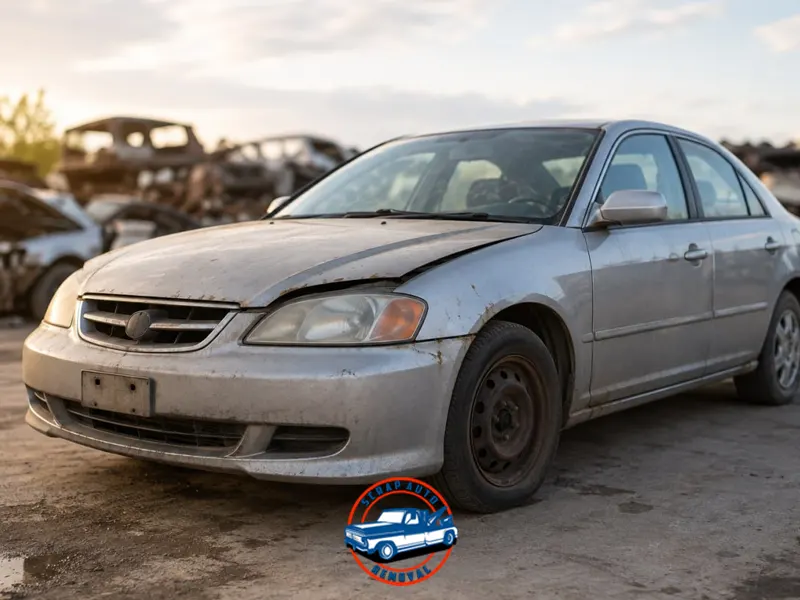
Worked Example: Pricing a 2012 Honda Civic With 200,000 km
Here’s how that adjustment actually plays out on a real, common vehicle.
Starting point: base scrap weight value. A compact sedan like this lands around CA$250 to $350 in raw metal value at current Alberta rates.
Running condition: plus CA$150 to $300. If the engine still turns over and the transmission functions, even roughly, that adds real value, since the drivetrain itself becomes resalable rather than just recyclable metal.
Catalytic converter, intact: plus CA$100 to $250. Standard, non-hybrid converters in Canada typically sell in the CA$40 to $1,200 range depending on precious metal content, and a factory Civic converter sits toward the lower-middle of that range, well below what a hybrid or luxury vehicle’s converter would bring.
Tires and battery, usable condition: plus CA$20 to $60. Small individually, but they add up.
Surface rust, no frame damage: no significant deduction. Cosmetic rust on a Calgary vehicle this age is expected and rarely moves the number much on its own.ّ
Realistic total: roughly CA$500 to $900, depending on the buyer’s exact pricing model and the day’s metal rates.
That range is wide because scrap pricing genuinely does move day to day with metal markets, but the components inside it are consistent and checkable on your own vehicle.
Three Real Scenarios That Change the Number
A seized engine, but a clean, rust-free body. This drops the running-condition bonus entirely, since the drivetrain is now scrap rather than resalable. But it doesn’t drop the number as far as people expect, since the body panels, glass, and undamaged parts still hold real value. The car above with a seized engine instead of a running one might land closer to CA$350 to $550.
Hail-damaged bodywork, fully running drivetrain. This is common in Calgary specifically, and it works the opposite direction from what owners often assume. Cosmetic hail damage barely touches scrap value, since scrap pricing is about weight and function, not appearance. A hail-damaged but mechanically sound version of the same Civic would likely price close to the full CA$500 to $900 range, not lower.
Missing catalytic converter. This is the single biggest individual deduction in the whole calculation. Removing the converter bonus entirely from the example above brings the range down to roughly CA$400 to $600, a meaningful drop from one missing part, since converters carry disproportionate value relative to their size, and converter theft has made this a real, common issue on Calgary vehicles.
What Doesn't Actually Affect Your Offer Much
A few things owners worry about that barely register in the calculation:
- Interior condition. Stains, wear, or a messy interior have essentially no effect on scrap value.
- Paint condition. Faded, chipped, or mismatched paint doesn’t factor into scrap pricing at all.
- Small dents and cosmetic damage. Unless it’s severe enough to indicate structural frame damage, minor dents don’t move the number.
Meanwhile, running condition and catalytic converter status, the two things that are easy to overlook when guessing at your own car’s worth, are consistently the biggest swing factors.
How to Use This to Sanity-Check Your Own Quote
Before you call for a quote, it helps to know roughly where your own vehicle sits:
- Does the engine turn over at all, even roughly? This is the single biggest yes/no factor.
- Is the catalytic converter still in place? Check underneath if you’re not sure.
- Are the tires holding air and the battery functional? Minor, but not nothing.
- Is any rust cosmetic, or does it affect the frame or structural panels?
Answering these four questions before you call gives you a rough sense of where your vehicle should land, so you can tell whether a quote is in a reasonable range or worth a second call to compare.
- Read Also:
The Bottom Line
A scrap car offer in Calgary isn’t a mystery number, it’s built from a base scrap weight value adjusted for a small, consistent set of factors: running condition, catalytic converter status, and genuine structural condition. Cosmetic things like paint and interior wear barely matter, while a seized engine or a missing converter can shift the total by hundreds of dollars. Knowing this before you call means you can look at your own vehicle with a realistic number in mind, rather than hoping whatever quote you get is a fair one.
FAQs
It starts with base scrap metal weight at current Alberta rates, then adjusts based on running condition, catalytic converter status, tire and battery condition, and structural damage. Two vehicles of the same year and model can price differently depending on these specific factors.
Yes, meaningfully. A running vehicle's engine and transmission hold resale value beyond scrap weight, while a non-running vehicle is typically valued closer to its raw metal and parts content alone, often several hundred dollars less than on a comparable vehicle.
Often the single biggest deduction in the calculation. Canadian scrap converter prices range from CA$40 to over $1,200, so losing that value can drop an offer by CA$100 to $250 or more depending on the vehicle and its converter type.
Not by that much. Paint condition, interior wear, and minor dents rarely move a scrap offer, since pricing is based on weight, function, and parts rather than appearance. Hail damage specifically barely affects value if the vehicle can still run.
Usually because of running condition and catalytic converter status. Two vehicles that look nearly identical can price very differently if one starts and the other doesn't, or if one still has its converter intact and the other has lost it.
Yes. Checking whether your engine turns over, confirming your catalytic converter is present, and noting any structural rust before you call gives a buyer what they need to quote more precisely, rather than adjusting the number after an in-person inspection.
Sources
- AMVIC (Alberta Motor Vehicle Industry Council) — vehicle condition disclosure and licensing verification
https://www.amvic.org/consumer/buying-a-vehicle/buying-used/ - Government of Alberta — Vehicle Bill of Sale form (ARP006)
https://formsmgmt.gov.ab.ca/Public/REG3126.xdp - ScrapMonster — live scrap steel and metals pricing by province, including Alberta
https://www.scrapmonster.com/scrap-yards/prices/alberta/state/3006 - ScrapMonster — industry explainer on precious metal content and pricing mechanics in catalytic converters
https://www.scrapmonster.com/news/catalytic-converter/understanding-precious-metals-in-catalytic-converters-2026-1-23/98246 - Natural Resources Canada — Platinum facts, confirming platinum group metal production, market value, and Canada’s role in the PGM supply chain
https://natural-resources.canada.ca/minerals-mining/mining-data-statistics-analysis/minerals-metals-facts/platinum-facts
Ready to Sell? We’re Ready to Buy!
Whether you prefer to call or request a quote online, we’re here to help you get the best value for your vehicle.